Students Skipping School 1980 British Punk Rock Fashion
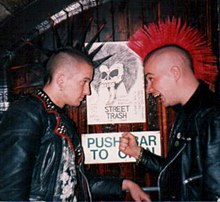
Two United kingdom punks in the 1980s
The history of the punk subculture involves the history of punk rock, the history of various punk ideologies, punk mode, punk visual fine art, punk literature, dance, and punk pic. Since emerging in the United States, the United Kingdom and Australia in the mid-1970s, the punk subculture has spread around the globe and evolved into a number of different forms. The history of punk plays an important part in the history of subcultures in the 20th century.
Antecedents and influences [edit]
Several precursors to the punk subculture had varying degrees of influence on that culture.
Art and philosophy [edit]
A number of philosophical and artistic movements were influences on and precursors to the punk motility. The most overt is riot, especially its artistic inceptions. The cultural critique and strategies for revolutionary action offered by the Situationist International in the 1950s and 1960s were an influence on the vanguard of the British punk motion, particularly the Sex Pistols. Pistols managing director Malcolm McLaren consciously embraced situationist ideas, which are too reflected in the clothing designed for the band past Vivienne Westwood and the visual artwork of the Situationist-affiliated Jamie Reid, who designed many of the band's graphics. Nihilism too had a paw in the development of punk's careless, humorous, and sometimes dour grapheme. Marxism gave punk some of its revolutionary zeal.
Several strains of modern fine art predictable and influenced punk. The relationship between punk rock and popular music has a articulate parallel with the blasphemy Dadaism held for the project of high art. If not a directly influence, futurism, with its interests in speed, conflict, and raw ability foreshadowed punk culture in a number of ways. Minimalism furnished punk with its unproblematic, stripped-down, and straightforward style. Some other source of punk's inception was pop fine art. Andy Warhol and his Factory studio played a major part in setting up what would become the New York punk scene. Popular art also influenced the look of punk visual art. In more than recent times, postmodernism has made headway into the punk scene.
Literature and film [edit]
Various writers, books, and literary movements were of import to the germination of the punk subculture. Poet Arthur Rimbaud provided the basis for Richard Hell's attitude, fashion, and hairstyle. Charles Dickens' working grade politics and unromantic depictions of disenfranchised street youth influenced British punk in a number of ways. Malcolm McLaren described the Sexual activity Pistols as Dickensian.
Punk was influenced by the Beat generation, especially Jack Kerouac, Allen Ginsberg, and William S. Burroughs. Kerouac'southward On the Route gave Jim Carroll the impetus to write The Basketball Diaries, maybe the first example of punk literature. George Orwell's dystopian novel 19 Eighty-Four might take inspired much of punk's distrust for the authorities. In his autobiography No Dogs, No Blacks, No Irish!, John Lydon remembers the influence that film version of A Clockwork Orange had on his own style. John Waters' 1972 secret archetype, Pink Flamingos, is considered an important precursor of punk culture.[1] [2]
Music [edit]
Punk rock has a diversity of origins. Garage rock was the beginning class of music chosen "punk",[3] and indeed that fashion influenced much of punk stone. Punk rock was also a reaction against tendencies that had overtaken popular music in the 1970s, including what the punks saw as "flatulent" forms of heavy metal, progressive rock and "arena rock" too equally "superficial" disco music (although in the United kingdom, many early Sex Pistols fans such equally the Bromley Contingent and Jordan quite liked disco, often congregating at nightclubs such as Louise'south in Soho and the Sombrero in Kensington. The rail "Beloved Hangover" by Diana Ross, the house anthem at the former, was cited as a detail favourite by many early UK Punks.)[4] The British punk movement also establish a precedent in the "practise-information technology-yourself" attitude of the Skiffle craze that emerged amid the post-World State of war 2 thrift of 1950s Britain.
In addition to the inspiration of those "garage bands" of the 1960s, the roots of punk rock draw on the snotty attitude, on-stage and off-stage violence, and ambitious instrumentation of The Who; the snotty attitude of the early Rolling Stones, which can be traced back to Eddie Cochran and Cistron Vincent of the late 1950s; the abrasive, dissonant mental breakdown style of The Velvet Clandestine; the sexuality, political confrontation, and on-stage violence of Detroit bands Alice Cooper, The Stooges and MC5; the English pub rock scene and political UK underground bands such as Mick Farren and the Deviants; the New York Dolls; and some British "glam rock" or "art rock" acts of the early 1970s, including T.Rex, David Bowie, Gary Glitter and Roxy Music. Influence from other musical genres, including reggae, funk, and rockabilly can as well be detected in early punk rock.
Earlier subcultures [edit]
Previous youth subcultures influenced diverse aspects of the punk subculture. The punk motion rejected the remnants of the hippie counterculture of the 1960s while at the same time preserving its distaste for the mainstream. Punk manner rejected the loose clothes, and bell-bottomed appearances of hippie mode.[ commendation needed ] At the same time, punks rejected the long hair adopted by hippies in favor of short, choppy haircuts, especially in the Britain as a follow on from the precursor Mod, Skinhead and the late sixties/early 70s Bootboy hairstyle fashions.[ citation needed ] The hippie crash pad found a new inception every bit punk houses. The jeans, T-shirts, chains, and leather jackets mutual in punk mode tin can be traced back to the bikers, rockers and greasers of earlier decades. The all-black attire and moral laxity of some Beatniks influenced the punk movement. Other subcultures that influenced the punk subculture, in terms of mode, music attitude or other factors include: Teddy Boys, Mods, skinheads and glam rockers.[ citation needed ] In 1991, Observer announcer John Windsor wrote a story about artist Frankie Stein - Precursor to Punk, observing that she was wearing a safety pin every bit earring some years before her friends in SexPistols picked it up and experimented in tandem with Sassoon artistic director Flint Whincop with hairstyles copied by people in her circumvolve such every bit Toya, Steve Foreign and what became The Sex activity Pistols.
Origins [edit]
The phrase "punk rock" (from "punk", significant a beginner or novice[5] [ citation needed ]), was originally practical to the untutored guitar-and-vocals-based rock and roll of The states bands of the mid-1960s such every bit The Standells, The Sonics, and The Seeds, bands that now are more ofttimes categorized as "garage rock". The earliest known example of a rock journalist using the term was Greg Shaw who used it to depict music of The Guess Who in the April 1971 outcome of Rolling Stone, which he refers to every bit "adept, not too imaginative, punk rock and roll". Dave Marsh also used the term in the May 1971 issue of Creem in reference to music by ? and the Mysterians.[6] The term was mainly used by rock music journalists in the early on 1970s to describe 60s garage bands and more contemporary acts influenced by them.[3] [7] In the liner notes of the 1972 anthology anthology Nuggets, critic and guitarist Lenny Kaye uses the term "punk-rock" to refer to the mid-60s garage rock groups, as well as some of the darker and more than primitive practitioners of 1960s psychedelic rock.[three]
The next stride in punk's early development, retroactively named protopunk, arose in the n-eastern Usa in cities such as Detroit, Boston, and New York. Bands such as the Velvet Underground, the Stooges,MC5, and The Dictators, coupled with daze rock acts like Alice Cooper, laid the foundation for punk in the The states. The transvestite community of New York inspired the New York Dolls, who led the charge as glam punk developed out of the wider glam rock movement. The drug subculture of Manhattan, particularly heroin users, formed the fetal stage of the New York punk scene. Art punk, exemplified past Television, grew out of the New York underworld of drug addicts and artists shortly after the emergence of glam punk.

Shortly after the time of those notes, Lenny Kaye (who had written the Nuggets liner notes) formed a ring with avant-garde poet Patti Smith. Smith's group, and her first album, Horses, released in 1975, directly inspired many of the mid-1970s punk rockers, so this suggests one path by which the term migrated to the music we now know as punk. There'south a scrap of controversy which isn't mentioned. The term punk was used to define the emerging movement was when posters saying "PUNK IS COMING! WATCH OUT!" were posted around New York City. Also, Punk Magazine would use the term and help popularize it. From this indicate on, punk would emerge as a separate and distinct subculture with its own identity, credo, and sense of style.
Economic recession, including a garbage strike, instilled much dissatisfaction with life amid the youth of industrial United kingdom of great britain and northern ireland. Punk rock in United kingdom of great britain and northern ireland coincided with the end of the era of mail-state of war consensus politics that preceded the rising of Thatcherism, and nigh all British punk bands expressed an attitude of aroused social alienation. Los Angeles was besides facing economical difficult times. A collection of fine art school students and a thriving drug hugger-mugger caused Los Angeles to develop one of the earliest punk scenes.
The original punk subculture was made up of a loose affiliation of several groups that emerged at divide times under dissimilar circumstances. There was pregnant cross-pollination between these subcultures, and some were derivative of others. Well-nigh of these subcultures are still extant, while others have since gone extinct. These subcultures interacted in various ways to form the original mainline punk subculture, which varied greatly from region to region.
New York [edit]
The beginning ongoing music scene that was assigned the "punk" label appeared in New York in 1974–1976 centered around bands that played regularly at the clubs Max's Kansas Urban center and CBGB. This had been preceded by a mini underground stone scene at the Mercer Arts Center, picking upward from the demise of the Velvet Clandestine, starting in 1971 and featuring the New York Dolls and Suicide, which helped to pave the mode, but came to an precipitous end in 1973 when the building collapsed.[8] The CBGB and Max'due south scene included The Ramones, Telly, Blondie, Patti Smith, Johnny Thunders (a former New York Doll) and the Heartbreakers, Richard Hell and the Voidoids and Talking Heads. The "punk" title was applied to these groups past early on 1976, when Punk Magazine first appeared, featuring these bands alongside articles on some of the immediate role models for the new groups, such as Lou Reed, who was on the cover of the first effect of Punk, and Patti Smith, embrace subject field on the second outcome.
At the same time, a less celebrated, but nonetheless highly influential, scene had appeared in Ohio, including The Electric Eels, Devo and Rocket from the Tombs, who in 1975 carve up into Pere Ubu and The Dead Boys. Malcolm McLaren, then manager of the New York Dolls, spotted Richard Hell and decided to bring Hell's look back to Britain[ citation needed ].
London [edit]
While the London bands may have played a relatively minor role in determining the early punk sound[ citation needed ], the London punk scene would come up to define and epitomize the rebellious punk civilization. Afterward a brief stint managing the New York Dolls at the end of their career in the US, Englishman Malcolm McLaren returned to London in May 1975. With Vivienne Westwood, he started a clothing store called Sexual practice that was instrumental in creating the radical punk clothing style. He also began managing The Swankers, who would soon go the Sexual activity Pistols. The Sex Pistols presently created a strong cult following in London, centered on a clique known as the Bromley Contingent (named after the suburb where many of them had grown upward), who followed them around the country.

Johnny Rotten and Steve Jones of the Sex Pistols
An frequently-cited moment in punk rock'southward history is a 4 July 1976 concert by the Ramones at the Roundhouse in London (The Stranglers were likewise on the bill). Many of the time to come leaders of the UK punk rock scene were inspired by this show, and most immediately subsequently it, the UK punk scene got into full swing. By the stop of 1976, many fans of the Sexual practice Pistols had formed their ain bands, including The Clash, Siouxsie and the Banshees, The Adverts, Generation X, The Slits and X-Ray Spex. Other UK bands to emerge in this milieu included The Damned (the first to release a single, the classic "New Rose"), The Jam, The Vibrators, Buzzcocks and the appropriately named London.
In December 1976, the Sex Pistols, The Clash, The Damned and Johnny Thunders & the Heartbreakers united for the Chaos Tour, a series of gigs throughout the UK. Many of the gigs were canceled by venue owners, later tabloid newspapers and other media seized on sensational stories regarding the antics of both the bands and their fans. The notoriety of punk rock in the U.k. was furthered by a televised incident that was widely publicized in the tabloid press; appearing on a London TV show called Thames Today, guitarist Steve Jones of the Sexual activity Pistols was goaded into a exact atmospherics past the host, Bill Grundy, swearing at him on live boob tube in violation of at the time accepted standards of propriety.
One of the starting time books about punk rock — The Male child Looked at Johnny by Julie Burchill and Tony Parsons (December 1977) — declared the punk motion to be already over: the subtitle was The Obituary of Rock and Roll. The title echoed a lyric from the title track of Patti Smith'southward 1975 album Horses.
Elsewhere [edit]
During this same period, bands that would later be recognized as "punk" were formed independently in other locations, such as The Saints in Brisbane, Australia, The Modern Lovers in Boston, and The Stranglers and the Sex Pistols in London. These early on bands also operated inside modest "scenes", often facilitated past enthusiastic impresarios who either operated venues, such every bit clubs, or organized temporary venues. In other cases, the bands or their managers improvised their own venues, such as a firm inhabited by The Saints in an inner suburb of Brisbane. The venues provided a showcase and meeting identify for the emerging musicians (the 100 Club in London, CBGB in New York, and The Masque in Hollywood are among the best known early punk clubs).
SFR Yugoslavia [edit]
The onetime Socialist Federal Commonwealth of Yugoslavia was not a fellow member of the Eastern Bloc, but a founding fellow member of the Non-Aligned Movement. Maintaining a more than liberal communist arrangement, sometimes referred to as Titoism, Yugoslavia was more opened to Western influences comparing to the other communist states. Hence, starting from the 1950s onwards, a well-developed Yugoslav rock scene was able to emerge with all its music genres and subgenres including punk stone, heavy metal and so on. The Yugoslav punk bands were the first punk rock acts always to emerge in a communist country.
Notable artists included: the pioneers Pankrti, Paraf and Pekinška patka (the starting time two formed in 1977, the latter in 1978), the 1980s hardcore punk acts: KUD Idijoti, Niet, KBO! and many others. Many bands from the first generation signed tape contracts with major labels such as Jugoton, Suzy Records and ZKP RTL and frequently appeared on TV and in the magazines, nonetheless some preferred contained labels and the DIY ethos. From punk stone emerged the new moving ridge and some bands, such as Prljavo kazalište and Električni orgazam decided to affiliate with it, becoming meridian acts of the Yugoslav new wave scene. The Yugoslav punk music as well included social commentary, which was generally tolerated, however there were certain cases of censorship and some punks faced occasional bug with the authorities.
The scene ceased to exist with the Yugoslav Wars in the 1990s, and its former artists continued their work in the independent countries that emerged afterwards the breakdown of Yugoslavia, where many of them were involved in anti-state of war activities and frequently clashed with the domestic chauvinists. Since the end of the wars and the departure of the nationalist leaders, the music scenes in the ex-Yugoslav countries re-established their former cooperation. The Yugoslav punk is considered an important part of the one-time Yugoslav culture, not but that it influenced the formation of the once vibrant Yugoslav new moving ridge scene but also information technology gave inspiration to some authentic domestic movements such every bit New Primitives and others.[9] [x] [11]
Kingdom of spain [edit]
In Espana, the punk rock scene emerged in 1978, when the country had just emerged from twoscore years of fascist dictatorship under General Franco, a state that "melded state repression with fundamentalist Cosmic moralism". Even after Franco died in 1975, the state went through a "volatile political period", in which the country had to try to relearn democratic values, and install a constitution. When punk emerged, it "did not appropriate socialism as its goal"; instead, information technology embraced "nihilism", and focused on keeping the memories of past abuses live, and accusing all of Spanish social club of collaborating with the fascist regime.[12]
The early punk scene included a range of marginalized and outcast people, including workers, unemployed, leftists, anarchists, queens, dykes, poseurs, scroungers, and niggling criminals. The scenes varied by metropolis. In Madrid, which had been the power center of Franco's Falangist party, the punk scene was like "a release valve" for the formerly repressed youth. In Barcelona, a city which had a particularly "marginalized condition under Franco", because he suppressed the area'south "Catalan language and culture", the youth felt an "exclusion from mainstream society" that enabled them to come up together and form a punk subculture.[12]
The first independently released Spanish punk disc was a 45 RPM record past Almen TNT in 1979. The vocal, which sounded similar the US band The Stooges stated that no one believed in revolution anymore, and it criticized the emerging consumer culture in Espana, as people flocked to the new department stores. The early Castilian punk records, most of which emerged in the explosion of punk in 1978, often reached back to "one-time-fashioned 50s rocknroll to glam to early metal to Detroit'south difficult proto-punk", creating an aggressive mix of fuzz guitar, jagged sounds, and crude Castilian slang lyrics.[12]
Late 1970s: diversification [edit]
In 1977, a second wave of bands emerged, influenced by those mentioned above. Some, such every bit The Misfits (from New Bailiwick of jersey), The Exploited (from Scotland), GBH (from England) Black Flag (from Los Angeles), Potent Little Fingers (from Northern Ireland) and Crass (from Essex) would go on to influence the move away from the original audio of punk stone, that would spawn the Hardcore subgenre.
Gradually punk became more than varied and less minimalist with bands such every bit The Disharmonism incorporating other musical influences similar reggae and rockabilly and jazz into their music. In the U.k., punk interacted with the Jamaican reggae and ska subcultures. The reggae influence is evident in much of the music of The Clash and The Slits, for example. By the terminate of the 1970s, punk had spawned the two Tone ska revival movement, including bands such as The Beat (The English Beat in U.S.), The Specials, Madness and The Selecter.
The message of punk remained subversive, counter-cultural, rebellious, and politically outspoken. Punk rock dealt with topics such as problems facing guild, oppression of the lower classes, the threat of a nuclear war, or it delineated the individual's personal problems, such every bit existence unemployed, or having particular emotional and/or mental issues, i.eastward. depression. Punk rock was a message to society that all was not well and all were not equal. While information technology is thought that the way of punk from the 1970s had a decline in the 1980s, many subgenres branched off playing their own interpretation of punk rock. Anarcho-punk become a style in its own right. Nazi punk arose as the radical right wing of punk.
1980s: farther diversification [edit]
Although almost of the prominent bands in the genre pre-dated the 1980s past a few years, it was non until the 1980s that journalist Garry Bushell gave the subgenre "Oi!" its name, partly derived from the Cockney Rejects song "Oi! Oi! Oi!". This movement featured bands such as Cock Sparrer, Cockney Rejects, Blitz, and Sham 69. Bands sharing the Ramones' bubblegum pop influences formed their own brand of punk, sporting melodic songs and lyrics more oft dealing with relationships and unproblematic fun than most punk rock's nihilism and anti-establishment stance. These bands, the founders of pop punk, included the Ramones, Buzzcocks, The Rezillos and Generation X.
As the punk movement began to lose steam, post-punk, new wave, and no wave took up much of the media'southward attention. In the U.k., meanwhile, diverse postal service-punk bands emerged, such equally Joy Division, Throbbing Gristle, Gang of 4, Siouxsie and the Banshees & Public Image Ltd, the latter two bands featuring people who were office of the original British punk rock move.
Sometime around the kickoff of the 1980s, punk underwent a renaissance every bit the hardcore punk subculture emerged. This subculture proved fertile in much the same fashion as the original punk subculture, producing several new groups. These subcultures stand up alongside the older subcultures under the punk banner. The United States saw the emergence of hardcore punk, which is known for fast, aggressive beats and political lyrics. It can exist argued, though, that Washington, DC was the site of hardcore punk's first emergence.
Early hardcore bands include Dead Kennedys, Black Flag, Bad Brains, the Descendents, The Replacements, and the Germs, and the movement developed via Minor Threat, the Minutemen, and Hüsker Dü, among others. In New York, at that place was a large hardcore punk movement led past bands such equally Agnostic Forepart, The Cro-Mags, Murphy's Law, Sick of It All, and Gorilla Biscuits. Other styles emerged from this new genre including skate punk, emo, and straight border.
Culling and indie legacy [edit]
The hole-and-corner punk movement in the The states in the 1980s produced countless bands that either evolved from a punk rock sound or claimed to apply its spirit and DIY ethics to a completely different sound. Past the end of the 1980s these bands had largely eclipsed their punk forebearers and were termed alternative rock. As alternative bands like Sonic Youth and the Pixies were starting to proceeds larger audiences, major labels sought to capitalize on a marketplace that had been growing underground for the past x years.
In 1991, Nirvana achieved huge commercial success with their album, Nevermind. Nirvana cited punk as a primal influence on their music. Although they tended to label themselves equally punk stone and championed many unknown punk icons (as did many other culling rock bands), Nirvana'due south music was as akin to other forms of garage or indie rock and heavy metallic that had existed for decades. Nirvana'south success kick-started the alternative rock smash that had been underway since the belatedly 1980s, and helped define that segment of the 1990s popular music milieu. The subsequent shift in taste among listeners of rock music was chronicled in a motion-picture show entitled 1991: The Year Punk Bankrupt, which featured Nirvana, Dinosaur Jr, and Sonic Youth; Nirvana also featured in the pic Hype! (United statesCHAOS).
1990s: American revival [edit]
A new movement in the mainstream became visible in the early and mid-1990s, claiming to be a form of punk, this was characterized by the scene at 924 Gilman Street, a venue in Berkeley, California, which featured bands such as Operation Ivy, Green Day, Rancid and subsequently bands including AFI, (though conspicuously not simultaneously, as Rancid included members of Operation Ivy, who had cleaved upward two years prior to the formation of Rancid).
Epitaph Records, an contained tape characterization started by Brett Gurewitz of Bad Religion, would get the domicile of the "skate punk" sound, characterized by bands similar The Offspring, Pennywise, NOFX, and The Suicide Machines, many bands arose claiming the mantle of the always-diverse punk genre—some playing a more than attainable, pop style and achieving commercial success. The tardily 1990s also saw another ska punk revival. This revival continues into the 2000s with bands like Streetlight Manifesto, Reel Big Fish, and Less Than Jake.
Pop punk [edit]
The commercial success of culling rock also gave style to another way which mainstream media claimed to be a grade of "punk", dubbed pop punk or "mall punk" by the press; this new movement gained success in the mainstream. Examples of bands labeled "pop punk" by MTV and like media outlets include; Glimmer 182, Unproblematic Plan, Good Charlotte, and Sum 41.
Past the late 1990s, punk was so ingrained in Western civilization that it was often used to sell commercial bands equally "rebels", amid complaints from punk rockers that, by being signed to major labels and appearing on MTV, these bands were buying into the system that punk was created to insubordinate against, and equally a result, could not be considered truthful punk (though clearly, punk'south earliest pioneers, such equally The Clash and The Sex Pistols also released piece of work via the major labels).
2000s and 2010s [edit]
There is still a thriving punk scene in Northward America, Australia, Asia and Europe. The widespread availability of the Internet and file sharing programs enables bands who would otherwise non be heard outside of their local scene to garner larger followings, and is in keeping with punk's DIY ethic. It has allowed a rise in interaction between punk scenes in different places and subgenres, as evidenced by events such as Fluff Fest in the Czech Republic, which brings together DIY punk enthusiasts from beyond Europe.[thirteen]
Footnotes [edit]
- ^ Gleiberman, Owen (eighteen April 1997). "Pink Flamingos". Amusement Weekly. Time Inc. Retrieved 11 March 2016.
- ^ Smithey, Cole (13 July 2014). "Capsules: Pinkish Flamingos". Cole Smithey. Retrieved 11 March 2016.
- ^ a b c [L. Kaye, liner notes to Nuggets LP compilation. Elektra Records. 1972]
- ^ England'due south Dreaming, Jon Savage Faber & Faber 1991, pp 93, 95, 185-186
- ^ "Punk". Merriam-Webster Online . Retrieved 6 Baronial 2010.
- ^ [D. Marsh, review of ? & The Mysterians. Creem Mag. May, 1971]
- ^ [G. Shaw. Rolling Stone, 4 Jan. 1973]
- ^ From the Velvets to the Voidoids: A Pre-Punk History for a Post-Punk Earth by Clinton Heylin, 1993, Penguin Books, ISBN 0-xiv-017970-4
- ^ Dragan Pavlov and Dejan Šunjka: Punk u Jugoslaviji (Punk in Yugoslavia), publisher: IGP Dedalus, 1990 (in Serbian, Croatian, and Slovene)
- ^ Janjatović, Petar. Ilustrovana Enciklopedija YU Rocka 1960–1997 (Illustrated Encyclopedia of YU Rock), publisher: Geopoetika, 1997 (in Serbian)
- ^ Interview with Igor Vidmar at Uzurlikzurli due east-zine (in English language)
- ^ a b c Drogas, Sexo, Y Un Dictador Muerto: 1978 on Vinyl in Spain. SHIT FI dot. http://world wide web.shit-fi.com/Articles/Spain1978/Spain1978.htm
- ^ Sanna, Jacopo (20 September 2017). "The Sincere and Vibrant Earth of the Czech DIY Scene". Bandcamp. Retrieved vii Oct 2017.
0 Response to "Students Skipping School 1980 British Punk Rock Fashion"
Post a Comment